
Railway employees including station masters, engine drivers, ticket checkers, etc too have been selected for vaccination and their list is being compiled for the exercise.

Fresh plans of privatisation or divestment in central public sector enterprises and public sector banks might take a back seat this financial year because these may require a large consensus among coalition partners.

In a major policy reversal, the AAP government wrote to the Centre to withdraw approval given by previous Congress government for FDI in multi-brand retailing in Delhi, saying the entry of global chains such as Walmart and Tesco in India would result in large-scale job losses.

The ministry of defence in September 2021 signed a Rs 21,935-crore contract with Airbus Defense and Space SA, Spain for supply of 56 aircraft.
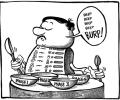
Indian food services sector is expected to grow at a CAGR (compounded annual growth rate) of 8.1 per cent between 2024 and 2028 on the back of rapid urbanisation, robust GDP growth, a rising younger population, and greater exposure among consumers, said a new report. The India Food Services Report-2024, brought out by the National Restaurants Association of India (NRAI), states that the sector contributes 1.9 per cent to India's GDP and is projected to grow to Rs 7.76 trillion by 2028 from Rs 5.69 trillion currently.

India's consumer price index (CPI)-based inflation could ease in the coming months thanks to the arrival of kharif crops, lower international commodity prices, and a pass through of lower input costs to consumers, the finance ministry said in its Monthly Economic Review (MER) for October, which was released on Thursday. The MER, however, warned that the global macroeconomic situation remained precarious and a recession in many advanced economies would impact India's exports. "Easing international commodity prices and new Kharif arrival are set to dampen inflationary pressures in the coming months.

'Given our turbulent neighbourhood, the prime minister is likely to emphasise on democratic dividend as the reason behind India's continuous prosperity.'
The finance ministry on Wednesday reimposed expenditure curbs on ministries and government departments for July-September quarter. There will be no spending restrictions on the ministries of health, rural development, agriculture, MSME (micro, small and medium enterprises) and railways as part of a two-pronged strategy. "The existing guidelines for expenditure control have been reviewed. "Keeping in view the evolving situation arising out of Covid-19 and anticipated cash position of the government, it is felt essential to regulate Quarterly Expenditure Plan (QEP)/Monthly Expenditure Plan (MEP) of specific ministries/departments for July-September, 2021," the Department of Economic Affairs in the finance ministry said in a notification.

Protocols for the Bomb Threat Assessment Committee (BTAC), convened in the event of a bomb threat call to an aircraft or airport, have been tweaked to better tackle the spate of the ongoing 'random' Internet-based threats being made to various Indian airlines, official sources said Tuesday.

The reservation would include a 10 per cent horizontal quota for Agniveers in the posts of constable, mining guard, forest guard, jail warden, and special police officers.

India's industrial production growth slipped to 3-month low of 5 per cent in April 2024, mainly due to poor show by the manufacturing sector, though mining and power segments performed well, according to official data released on Wednesday. Factory output growth, measured in terms of the Index of Industrial Production (IIP), was 5.4 per cent in March and 5.6 per cent in February 2024. The previous low of IIP was recorded at 4.2 per cent in January, 2024.

Industrial production declined by 10.4 per cent in July, mainly due to lower output of manufacturing, mining and power generation, as per the government data released on Friday.

To boost domestic manufacturing under the Make in India initiative and reduce dependency on imports, the government is expected to announce in the Budget an increase in the minimum local content requirement for public procurement, with certain sectors being granted exceptions. Currently, firms producing goods, services, or works with at least 50 per cent local content are classified as Class-I local suppliers and are preferred the most in government procurement.

Pseudonymous or anonymous nature of the social media handle, analysis of the geopolitical situation and presence of VIPs onboard are some of the new criteria that agencies will keep in mind while considering the seriousness of a bomb threat made to Indian airlines.

Following the disengagement, both sides will soon start the coordinated patrolling in their respective areas, sources added.

India has reduced the time period for foreign investors to seek international arbitration from five years to three years as part of the recently signed investment pact with the United Arab Emirates (UAE), a departure from its model Bilateral Investment Treaty (BIT). Under the Investor-State Dispute Settlement (ISDS) mechanism, if the Indian judicial system is unable to resolve a dispute within this shortened period, investors can resort to international arbitration. The investment pact, signed on February 13 in Abu Dhabi, came into force on August 31, replacing the previous pact.

Union minister Chirag Paswan has caused a flutter by stating he would choose to give up his ministerial berth instead of a compromise on his principles, in keeping with the precedent set by his late father Ram Vilas Paswan.

Manufacturing sector production registered a decline of 17.1 per cent, while the output of mining and power fell 19.8 per cent and 10 per cent, respectively.

Tech and startup industry bodies have again pushed back against calls by telecom operators to bring over-the-top (OTT) services under a licensing regime similar to telcos, and open them up to taxation. Ahead of public consultations on the issue later this week, the Internet & Mobile Association of India (IAMAI), Nasscom and the US India Strategic Partnership Forum (USISPF), among others, have written to the government arguing against such efforts.

The government is likely to introduce a bill seeking amendments to the Insurance Act, 1938, during the upcoming Budget session to achieve 'Insurance for All by 2047'. Some of the provisions, which could be part of the amendment bill, include composite license, differential capital, reduction in solvency norms, issuing captive license, change in investment regulations, one-time registration for intermediaries and allowing insurers to distribute other financial products, sources said.

India is planning to soon sign new and updated mineral pacts with about a dozen countries in Africa. The Ministry of Mines is in discussions with Cte d'Ivoire, Democratic Republic of the Congo (DRC), Madagascar, Malawi, Mali, Morocco, Mozambique, South Africa, Tanzania, Zambia and Zimbabwe, Business Standard has learnt. Negotiations are ongoing with around a dozen countries, and more will be added to the list soon.

The final Budget for the fiscal is likely to be tabled in July after formation of the new government.

The total allocation to the defence sector is 12.9 per cent of the total budget of the government of India for the financial year 2024-25.

Wholesale inflation in the country rose for the fourth consecutive month in June at 3.36 per cent on account of rise in prices of food articles, especially vegetables and manufactured items. The wholesale price index (WPI) based inflation was 2.61 per cent in May. It was (-) 4.18 per cent in June 2023.

The Ministry of Heavy Industries has approved 11 electric vehicle (EV) manufacturers, including Ather Energy, Bajaj Auto, Hero MotoCorp, Ola Electric, and Mahindra, to receive incentives under the recently introduced Electric Mobility Promotion Scheme (EMPS) 2024. "A total of 11 firms have been granted approval under the EMPS, with several more under consideration," informed a senior official of the ministry to Business Standard. The scheme aims to sustain the growth in EV sales, replacing the Faster Adoption and Manufacturing of Electric Vehicles - II (FAME-II) scheme.

The generation of quality jobs and skill development should be the focal point, cutting across ministries and departments, asserts Nivedita Mookerji.
